Track Record
A sample of our portfolio
Both parties anonymous7-figure
We closed it7-figure
on announcement7-figure
4 years of patience7-figure
Our Story
Why VPN.com became a domain brokerage
In 2014, Michael Gargiulo found the perfect domain for his cybersecurity venture. VPN.com. It wasn't for sale.
He spent four years building a relationship with the owner. No pressure. No ultimatums. When the owner was finally ready, Michael was the first call.
The asking price was nearly $2 million. They closed at $976,730, saving $750K through patient, professional negotiation.
Then Michael met Sharjil Saleem. Together they built the brokerage that now handles deals from $25,000 to $25 million.


Frequently Asked Questions
Do you share my information with the other party during negotiation?
No: we communicate confidentially as long as possible, sometimes throughout the entire process. However if a purchase agreement is acquired, disclosure may occur towards the very end.
What affects a domain’s value?
Domain extension, domain length, length of registry, commercial viability, other exact match domains with different extensions, existing trademarks preventing historical use of the domain, international search volume, character types in use. Alpha-only or numerical-only domains are generally the highest value.
Can you help me find similar domains if my first choice isn’t available?
Absolutely: in fact we recommend a variety of offensive and defensive acquisitions with our standard engagement. A $995 value, absolutely free.
What happens if you can’t acquire or transact my domain name?
There is no upfront cost, and no cost along the way. If your domain transaction does not happen the engagement will conclude on the 6, 12 or designated term length, in which case there would be no broker fee owed at all. However, contacts that were made by our brokerage team are generally protected for commission purposes for the following 12 months after the term ends: should a transaction occur with them, our commission would still be owed.
Are brokerage fees refundable?
No. Transactions are as-is, without warranty. There are no refunds, returns or exchanges once a transaction enters escrow or purchase and sale agreement.
Who pays the escrow fees?
We aim to have these fees split as this is the fairest way to navigate the security escrow provides. It is possible to have either party cover the fee in full.
Can I communicate directly with the other party?
While this sometimes may need to occur, it generally is reserved for the very late stage of a transaction. We do not recommend speaking directly with the other party as this can risk certain elements of the negotiation, and experienced counterparties can take advantage of you as a result. Your privacy is one of the most powerful things we can help protect during the negotiations.
When is the escrow payment released?
Only upon the inspection completion period, which is agreed to ahead of funding and usually lasts 1-3 days upon your acceptance of the domain in your account. Funds would be released to the assigned party thereafter.
Can you handle installment purchases?
Yes, and we only use escrow domain name holding service to ensure payments are received on time. Should payments not be paid on time or within the period, escrow will return the domain to the seller and conclude the transaction.
Can I lease or finance a premium domain name?
It is possible on a case by case basis, depending on the seller’s willingness, down payment size, timeline to completion, and other related terms.
How do I know the domain is really mine?
You see the domain in your registrar account, and you have access and control of the DNS.
Can you help acquire an entire domain portfolio?
For portfolios over $50,000 this is certainly something we can help with. If you are looking to assemble a portfolio, we can assist in this as well.
Can you broker domains worth over $1m?
Yes. Seven-figure transactions are the deals we are built for — we have advised on over $100M in portfolio and transactions. We are here to help on large, delicate deals to support your vision, expand your reach and enhance your cash flows.
How long does the process take?
Anywhere from one week to multiple years. It took us 4 years to acquire vpn.com: we are aware life-changing deals take time, but understand closing deals promptly is what our clients desire.
What due diligence should I complete?
All research and due diligence your legal and financial teams advise you on: any concerns, risks, liabilities, or possible unfavorable outcomes to be reviewed by your team exclusively. Your DD responsibility is critical, as a domain broker only facilitates arranging transaction details.
What happens if the other party isn’t responsive to the inquiry?
We have an extensive track record of creative contact and engagement approaches including digital outreach, in-person visits, mail and shipment of physical material, faxes, along with extensive record access for navigating difficult-to-find ownership history that may involve death, divorce, disablement, account abandonment, bankruptcy, and other complicated legal structures. Consult with your legal team after clarity is provided.
Are domains the only thing you can help acquire?
We can assist with a variety of acquisitions and transactions, pending your exact needs and regulation. We are not a law firm, financial advisory, CPA firm or real estate broker. We can help acquire intellectual property and business assets that can bolster your vision and cash flow.
What are defensive/offensive acquisition strategies? What is a flanking brand acquisition?
This is an additional domain aside from your core business domain that supports the commercial or informational activity of your brand, while usually relating to your exact keyword or geo area your prospects are searching in.
How often will I receive updates?
We update you when we have something worthy of your time.
Are there any costs during the engagement?
No: nothing upfront or during. Only when we deliver.
What if I change my mind?
Give us 60 days notice.
How easy is it to be engaged?
2 page document, you click to sign.
Do I need a separate purchase and sale agreement in addition to the escrow agreement?
Speak to your counsel: this is certainly something we can assist your team with.
What is VPN.com’s fee?
15%-35%+, depending on a variety of factors including value, documentation needs, funding terms, deal complexity and timeline. Smaller deals have a higher percentage.
What is a domain transfer?
We deliver the domain to you with whatever method is fastest, which usually is an account push at the current registrar.
What is an auth/EPP code?
If a domain push is unavailable, we can arrange an auth code to be delivered to you at your registrar to initiate the domain transfer.
Where can I find instructions on the account change or transfer process?
Contact your domain broker, or search the existing registrar + “domain transfer” (example: godaddy.com domain transfer).
Does my domain engagement need to match my escrow account?
The domain engagement, the escrow account, and your bank records need to all match the same person or entity. This is required by escrow and can delay your transaction closing if not set up and funded correctly.
How long should I renew my domain after the transaction?
Because these are premium domains, we recommend as long as your registrar permits.
Do I need an SSL certificate?
Yes, unless you have forwarding set up.
When can I set up my new website?
As soon as you have access to the domain in your account, and have DNS instructions from your technical team to update name servers or other domain records.
When can I set up email addresses on my new domain?
As soon as you have access to the domain in your account, and have DNS instructions from your technical team to update name servers or other domain records.
How will I know if the domain is fully propagated?
Complete a global DNS test using a 3rd party tool.
Should I add privacy protection to the domain?
We generally recommend yes, unless your team advises otherwise.
Should I activate 2FA on my domain registrar account that received the premium domain name?
You should activate all available 2FA modes including generating a passkey and recovery phrases for your account, which should be stored in a password manager or other extremely secure location.
What payment settings should I have enabled at my registrar?
We recommend multiple active payment methods with far-into-the-future expiration dates to make renewals seamless and automatic. In addition, if available at your registrar, we recommend funding $150 to be available if payment methods decline or expire.
What other registrar settings are important?
Ensure the domain is locked and email notifications are being sent to the appropriate email.
What root domain should I select?
www vs non-www, https vs non-https, trailing slash vs non-trailing-slash. domain.com/example is not the same as www.domain.com/example/.
When should I consult my attorney about first use in commerce?
Immediately. You should have any trademark, copyright, intellectual property, DD, and risk-related questions reviewed by your legal and advisory teams as they come up internally. The sooner your domain is used in commerce, the earlier trademark rights may be available depending on your use.
Do I get a discount for repeat purchases?
Yes, we have a repeat transaction discount: please speak to your assigned domain broker today.
Is there any incentive for me to refer friends, family or other executives that would do business with you?
Yes, depending on the type of referral. Get in touch with your domain broker for more details. In general it needs to be someone we haven’t communicated with before and who engages in a formal agreement with us. Typically the referral fee is 10%.
What security settings should I have at my registrar?
Ensure you have the longest password possible, the domain is locked, privacy protection is on, no old or unused domain records, DMARC is activated with SPF records to prevent email abuse, multiple 2FA is enabled in case a phone or password is lost, long-term access to the registered email is maintained, your email system has long-term billing enabled, your email has 2FA at the highest security settings available, and use passkeys when possible.
What locations do you serve?
Including but not limited to all US states and the top 50 GDP countries.
Countries we do not serve: all OFAC-restricted countries (Cuba, Iran, North Korea) and countries restricted by the OFAC Specially Designated Nationals and Blocked Persons list.
Domain Broker Service Explained
Bottom Line: A domain broker helps buyers and sellers acquire or sell high-value domain names through confidential outreach, valuation, negotiation, escrow, and secure transfer. Most premium domains are already owned and never publicly listed, so a broker reaches the owner discreetly and negotiates without revealing your identity or inflating the price. VPN.com acts as a premium domain broker for domains valued at five, six and seven figures, with no upfront fees.
A premium domain can shape how a business is perceived before anyone reads a single word on the website.
The right name builds trust faster, looks more authoritative and creates a stronger position in the market. The challenge is that most high-value domains are already owned, rarely priced rationally and difficult to acquire without experience.
This is where a domain broker becomes essential.
VPN.com helps businesses, founders and investors secure premium domains through confidential outreach, structured negotiation and a process designed to reduce risk while improving deal outcomes.
What is a Domain Broker?
A domain broker is a specialist who facilitates the purchase or sale of domain names that are not openly available for sale. When a desirable name is already registered, there is no “Buy Now” button.
A broker becomes the professional intermediary who locates the owner, initiates confidential contact, negotiates a fair price and manages the entire transaction through secure escrow. Not sure if you need one? Here’s how to decide if a domain broker is right for you.
We protect buyer anonymity so sellers cannot research your company and inflate the asking price. For sellers, we screen out lowball investors and connect you only with serious end-user buyers who can pay true market value. Every step is designed to minimize risk, maintain confidentiality and maximize outcome.
Why Hire a Premium Domain Broker?

Most companies buy or sell a high-value domain only once or twice in their lifetime. Professional domain investors and portfolio holders, by contrast, transact dozens of times per year. This experience gap frequently costs buyers hundreds of thousands of dollars or even millions.
Businesses hire a domain broker when:
- The ideal domain is already registered and the owner cannot be reached through normal channels
- Sellers may research the buyer’s brand, funding round or industry and dramatically increase the price
- The buyer lacks current market comps and does not know what the name is truly worth in today’s economy
- A single misstep in negotiation or contract language can add six or seven figures to the final cost
- Escrow, transfer and legal language carry risks that only experienced professionals can fully mitigate
A skilled broker converts a high-stakes, one-time transaction into a controlled, strategic process that protects your brand equity and delivers measurable ROI.
Buy-Side vs Sell-Side Domain Brokerage
VPN.com provides expert representation on both sides of the transaction. We regularly work with founders, executives and brand managers who need discreet, high-stakes acquisitions.
Buy-Side Services
We help you buy premium domains that are already taken, hidden behind privacy protection or strategically held. We manage the narrative, shield your identity and negotiate terms that align with your brand and budget rather than the seller’s assumptions.
Sell-Side Services
We help you sell premium domains that are sitting unused, accumulating renewal fees or receiving only lowball offers. Our network reaches serious end-user buyers who value the name for its branding potential, not just speculative resale. We position the asset, run a controlled process and maximize your exit value.
Our Core Domain Brokerage Services

Most domain problems don’t stop at buying or selling. In many cases, the real challenge is determining a domain’s value, changing your domain name without losing brand equity or buying it without putting yourself in the spotlight.
At VPN.com, we provide specific solutions to all these issues.
Domain Appraisal & Valuation
We deliver independent, data-backed domain valuations grounded in actual sales comps, keyword metrics, brand strength, industry demand and current market conditions. This gives you pricing confidence before negotiations begin and prevents both overpaying and underselling valuable digital assets.
Stealth Domain Acquisition
Our most discreet service, built for confidential domain acquisition. Your identity, company name and intentions remain completely hidden throughout outreach and negotiation. This prevents price inflation and increases success rates on tightly held or strategically important domains.
Anonymous Domain Acquisition
We structure the purchase so your ownership details are shielded in public WHOIS records after closing. This reduces the risks of spam, solicitation and brand impersonation while maintaining full regulatory compliance.
Secure Escrow & Transfer Management
Every transaction is routed through vetted escrow services[1]. We handle all paperwork, verify transfer codes and ensure a clean title to protect both parties.
The Domain Brokerage Process
Our process is designed for transparency and speed. It typically follows six stages: initial consultation and goal-setting, comprehensive valuation and strategy development, discreet owner outreach, structured negotiation with clear leverage points, contract and escrow coordination and final transfer with post-sale support.
Most acquisitions close within 30–90 days, although complex or high-value deals may take longer. Throughout, you receive regular updates while we maintain complete confidentiality.
Why Choose VPN.com as Your Premium Domain Broker?
VPN.com is not a passive marketplace, registrar upsell or DIY tool. We are a specialized premium brokerage focused exclusively on category-defining names valued at five, six and seven figures.
- No upfront fees: We earn a modest 15% commission only when a deal successfully closes. Our incentives are perfectly aligned with yours.
- Proven expertise: Led by Michael Gargiulo and VP Sharjil Saleem, our team understands precise-match domains, negotiation psychology, market timing and cybersecurity implications.
- Cybersecurity advantage: We help clients choose domains that shrink their attack surface by preventing typosquatting and phishing vectors that exploit weak or similar-sounding names.
- Buy- and sell-side experience: Across transactions for major brands in tech, finance, gaming and international markets.
Domain Broker vs Marketplace vs DIY Outreach
When a domain can shape your entire brand, how you pursue it matters.
| Factor | VPN.com Brokerage | Public Marketplaces | DIY Outreach |
|---|---|---|---|
| Anonymity | ✓ | ✕ | ✕ |
| Professional Valuation | ✓ | ✕ | ✕ |
| Active Reach & Outreach | ✓ | ✕ | ✕ |
| Negotiation Power | ✓ | ✕ | ✕ |
| Transaction Safety | ✓ | ✓ | ✕ |
| Time & Resource Efficiency | ✓ | ✕ | ✕ |
| Overall Success Rate | ✓ | ✕ | ✕ |
Our Results and Domain Success Stories
In the case of premium domains that you entrust to a broker, you would want to see evidence of their ability to deliver. This is what VPN.com has accomplished with customers in the gaming, financial, tech and international brands.
Stats at a glance:
- Over $100M in portfolio and transactions
- Deals ranging from $100K to multi-million dollars
| Case Study | Challenge | Result |
|---|---|---|
| Meet.com (Huuuge Inc.) | Needed a category-defining domain for a gaming community that the owner wasn’t selling and previous attempts had failed. | Acquired Meet.com, significantly boosting Huuuge’s digital presence in online gaming. |
| Asset.com | Financial client needed a global brand asset from an owner with no interest in selling. | Closed a multi-million-dollar deal, securing one of the most powerful domains in finance. |
| DXB.com | Buyer required a premium three-letter .com tied to Dubai rare, expensive and notoriously difficult to acquire. | Completed acquisition of DXB.com, securing an elite global brand asset. |
Ready to Secure the Right Domain?
If the domain you want is already taken or you are looking to sell a premium asset at its true value, VPN.com is ready to help. We handle every detail, discreet outreach, expert negotiation, secure transfer and post-sale support with complete transparency and professionalism.
Tell us your goal (acquire or sell) and we will provide an honest assessment and clear next steps with no pressure and no hidden terms.
DISCLOSURE: Informational purposes only. Actual outcomes may vary. Do your own due diligence.
References
Resources for this page
Charts and reference images from our testing, free to view and share.
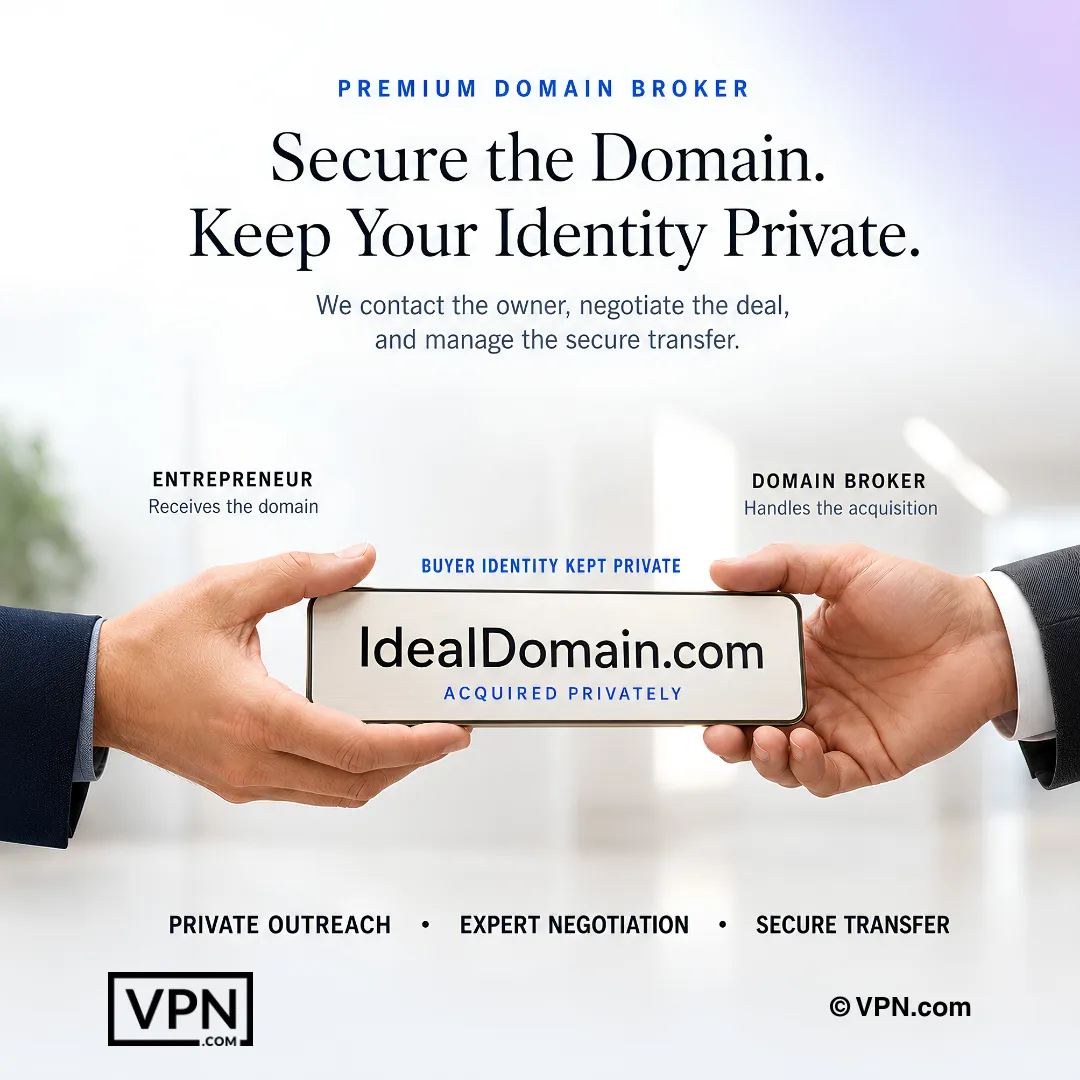
A domain broker connects the buyer with the current owner, negotiates the agreement, and coordinates the secure transfer. 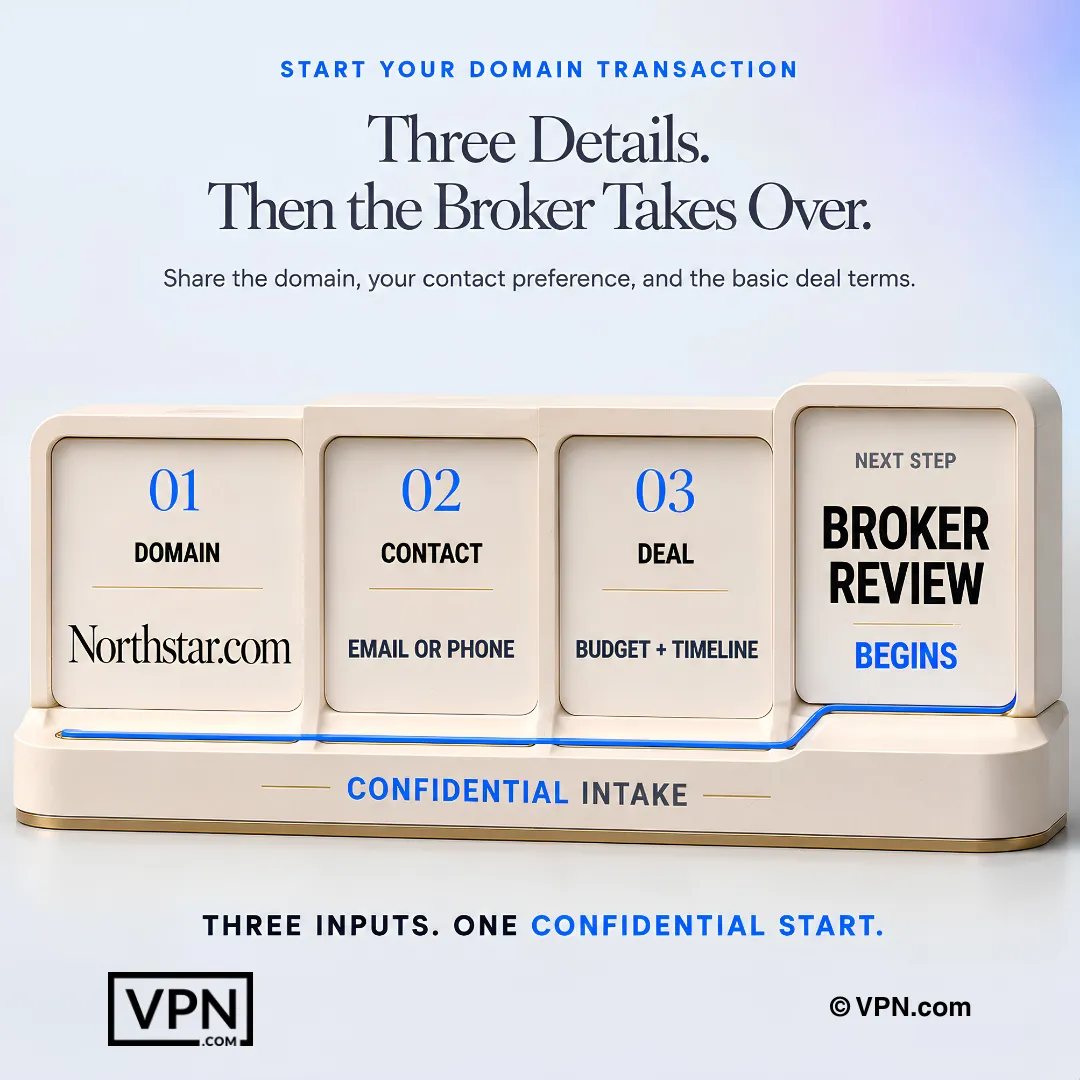
Share three essential details and the broker can begin reviewing the domain transaction confidentially.
Latest Domain Guides
Buy Premium Domain: Expert Broker Service
Buy premium domain names through our broker service. We've advised on over $100M in portfolio and transactions with zero fees until closing. Start your confidential purchase today.
Confidential Domain Acquisition: Buy Domains Anonymously
Acquire premium domains without revealing your identity. VPN.com's confidential brokerage protects your leverage and keeps negotiations private.
Domain Valuation: How Much Is Your Domain Worth?
Get an accurate domain valuation from VPN.com. We assess comparable sales, traffic, brand potential, and market demand to price your domain correctly.
Sell Premium Domain Names for Maximum Value
Sell your premium domain with expert broker representation. We've advised on over $100M in portfolio and transactions and negotiate top prices with zero upfront fees.
.com vs .xyz: The Real Differences Every Brand Should Know
Not sure whether to choose .com vs .xyz for your brand? We cover trust SEO email deliverability and cost to help you make a clear decision right now.
Domain Name and URL: What's the Difference?
Learn the key differences between domain name and URL. Understand how each works and why getting them right matters for your website's SEO and security.
We paid $976K for VPN.com.
It wasn't for sale. We got it anyway — and saved $750K at the table. Tell us what you want and we'll do the same for you.
Get your callback